


Review: Brick‘R‘knowledge – Learn everything from Ω to GHz
December 15, 2016
on
on
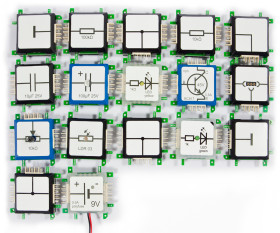
Brick‘R‘knowledgeelectronic construction set
comprises 19 blocks, just enough to make you want it.
Brick‘R‘knowledge: everything from Ω to GHz
At first glance, this modular system for learning electronics, from the company Allnet, seems of the type to arouse interest in anyone with an educational bone in their body,
Now you’re talking!
This question was in my mind while I was discovering this system. Let’s look at where I stand now after playing around with the basic and extended configurations (photos opposite).
The Brick‘R‘knowledge project is ambitious; its breadth increases as you discover more of it. It was launched in 2104 at a radio amateurs’ conference, by Rolf-Dieter Klein (DM7RDK). If I mention his callsign, it’s not just to confirm the German origin of this project, but for other reasons which will soon become clear.
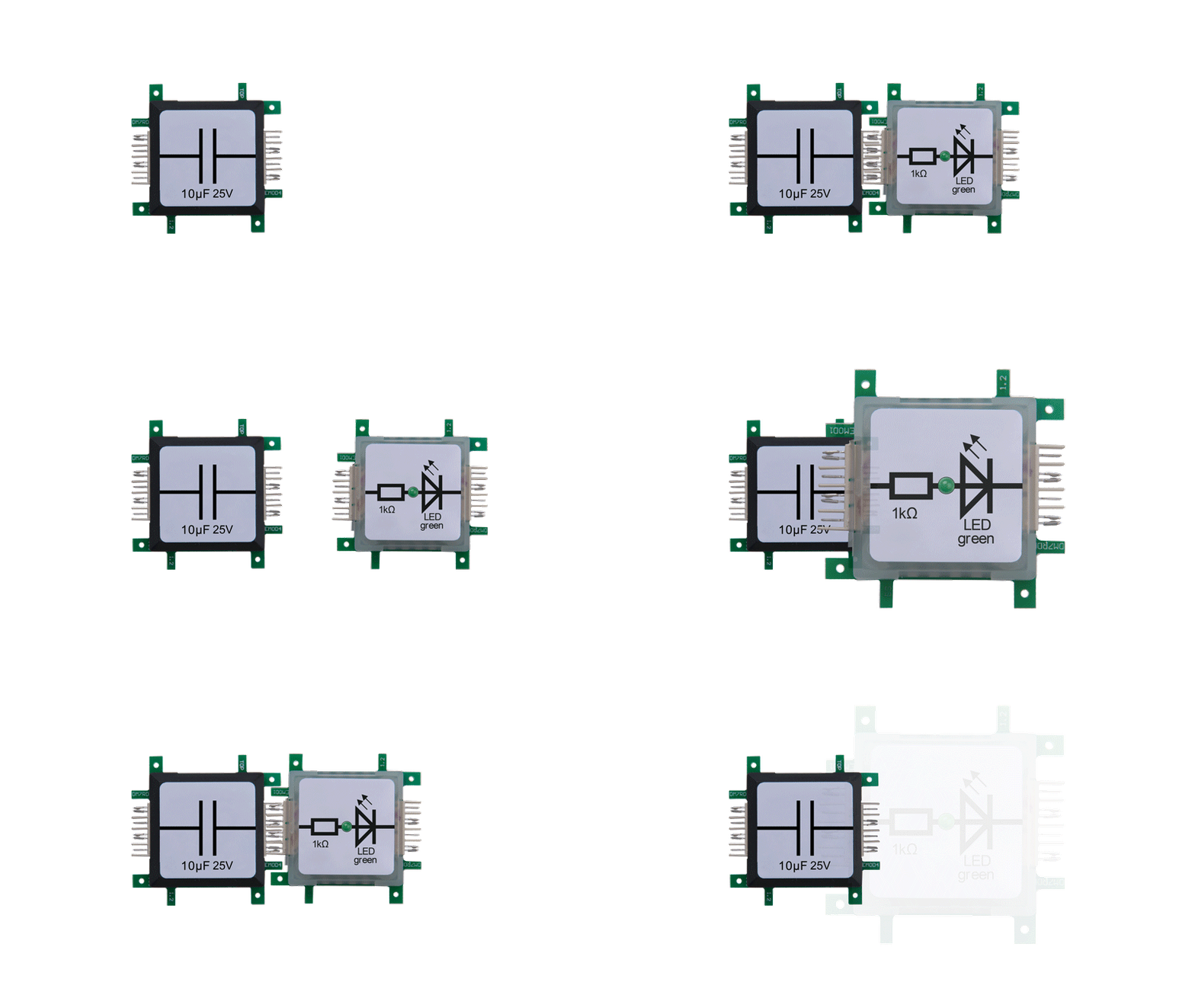 It is offered in English and in other languages, it’s a rich, varied, coherent collection, with several dozen different modules: it encourages beginners, once past the initial learning stage, to rub shoulders with Arduino, photovoltaic techniques, tubes and even…. radio frequencies. And that was unexpected! At the heart of this open system is a concept of dominoes, horizontally stackable, mostly 3.5 cm square, some bigger, but all multiples of the base size, compatible electrically and mechanically, with usually only one component per block.
Hermaphroditic connectors

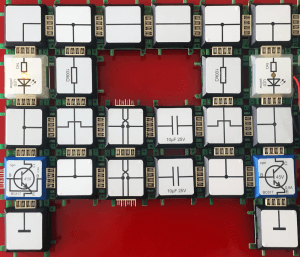
Astable multivibrator (Image: Michael Knieling)
Some modules permit crossing or multiplying lines. For example, to the side is the crossing of the base lines in a two-transistor astable multivibrator. If the learner connects one of the two crossing blocks (to the left of the capacitors) the wrong way round, the circuit will not oscillate. This may seem trivial, but it illustrates that you can’t just connect the blocks together; a little attention and judgment are needed. Before getting to this multivibrator, the learner will have already assembled thirty or so simple circuits.
So that the learner does not get lost in this abundance, the color of the edge of the block indicates its type. Not sure if this helps a lot, but it does show richness and variety: DIY | Passive | Active Basic | Actuator/sensor | Opto | System | integrated-circuit | HF MHz* | HF GHz*
The assembly of so many blocks poses no risk of bad contacts; the construction can be moved easily. Its mechanical rigidity is such that the modules can be used even by clumsy learners.
* Yes, you read that right: MHz and GHz... we’ll get back to this!
Read full article
Hide full article
Discussion (0 comments)