Elektor serves tens of thousands of paying members with trusted, high-quality electronics content. Members get access to exclusive online articles—sometimes before they appear in the magazine—plus the ability to join the discussion around featured projects. Not a member? You can buy an article for €5.
Brushed DC Motor Speed Control: EMF Measurement Instead of Tachogenerator
Brushed DC Motor Speed Control: EMF Measurement Instead of Tachogenerator
Brushed DC motors are increasingly being replaced by brushless (BLDC) and stepper motor competitors. But their use still makes sense, as the control effort is considerably lower. Here we show how to keep the speed of a DC motor with brushes constant regardless of the torque — and without a tachometer generator.
Brushed DC motors are increasingly being replaced by brushless (BLDC) and stepper motor competitors. But their use still makes sense, as the control effort is considerably lower. Here we show how to keep the speed of a DC motor with brushes constant regardless of the torque — and without a tachometer generator.
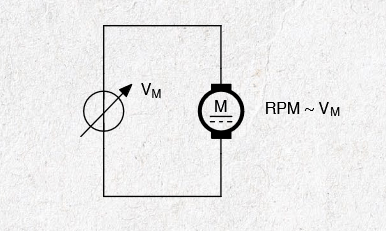
In the simplest case, a DC motor is connected to a variable voltage supply, as shown in Figure1. The speed is (theoretically) proportional to the supply voltage VM, but only as long as the torque is constant.
Figure 1: In an ideal world, the speed is proportional to the motor voltage.
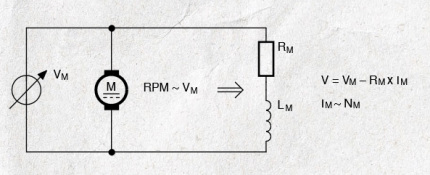
Unfortunately, the equivalent circuit diagram of the DC motor looks like Figure2. The motor winding not only has an inductance LM, but also an ohmic resistance of the copper wire, which is designated by RM. The higher the torque, the more voltage drops across RM, until finally there is no more voltage across the inductance LM and the motor stops (Figure3).